When Software Stops Being Used and Starts Acting

A particular argument is gaining traction among people building and operating enterprise software: as systems become agentic, total addressable market expands, pricing models must evolve, and the long-standing logic of selling software by the seat begins to weaken. When work itself is automated, counting humans becomes a poor proxy for value. This argument is not consensus, but it resonates because it reflects a real shift already underway inside large organizations.
What is less examined is why these claims about market expansion and pricing change keep resurfacing, and what they imply for the structure of the enterprise software stack itself. If agents increasingly plan, decide, and execute work, where does durable value actually concentrate, and which layers of today’s stack are structurally advantaged or exposed?
The reason these arguments about TAM and pricing have traction is structural rather than speculative. As agents take on work that previously required human attention, software begins to absorb not just usage, but responsibility. Decisions that once lived in people now live in systems. Execution that once scaled with headcount now scales with compute, policy, and authority. TAM expands because software is no longer sold merely as access to tools, but as capacity to perform work. Pricing models change because value is no longer tied to seats, but to outcomes, responsibility, and risk.
It is tempting to assume that existing enterprise platforms naturally carry their position forward, largely because they are deeply embedded, operationally critical, and costly to unwind. They already sit inside governance, compliance, and risk frameworks. This does not imply that all incumbents survive, but it does reflect a meaningful structural advantage.
That advantage, however, is conditional.
The strongest case for traditional SaaS lies in regulatory binding. Enterprise systems do not simply store information; they confer legal, audit, and institutional standing. A record inside a governed system is treated as authoritative in ways that an external artifact is not. Permissions, audit trails, retention policies, and compliance certifications transform data into institutional truth. Enterprises are not just buying functionality; they are buying legitimacy.
Regulation creates durability, but it governs records, not intent.
As software shifts from being used by humans to acting on their behalf, the center of gravity moves upstream from storage to decision-making. The most consequential questions are no longer about where data lives, but about who decides what should happen, under what constraints, with what authority, and with what recourse when outcomes diverge from expectations. Regulatory frameworks validate what was recorded, not how a decision was formed or why an action was taken in the moment.
Audit logs explain what happened. Compliance constrains behavior after the fact. Neither determines how intent is formed or how execution unfolds in real time.
This is where the economics of enterprise software begin to change.
Regulation ensures that context providers remain in the stack, but it does not anchor pricing power at that layer. As agentic systems mature, value migrates upward toward decision-making and execution, because those layers absorb responsibility, risk, and accountability. Storage and interface layers remain necessary, but necessity alone does not protect margins when differentiation thins.
If legacy platforms are unable to move up the stack and take on decision authority or execution ownership, they increasingly compete on the properties of context provision and presentation, where efficiency gains, abstraction, and standardization tend to compress margins over time. Pricing pressure follows not because these systems are no longer used, but because they no longer define outcomes.
Viewed this way, agentic systems reorganize the enterprise stack around authority rather than functionality.
The Agentic Stack
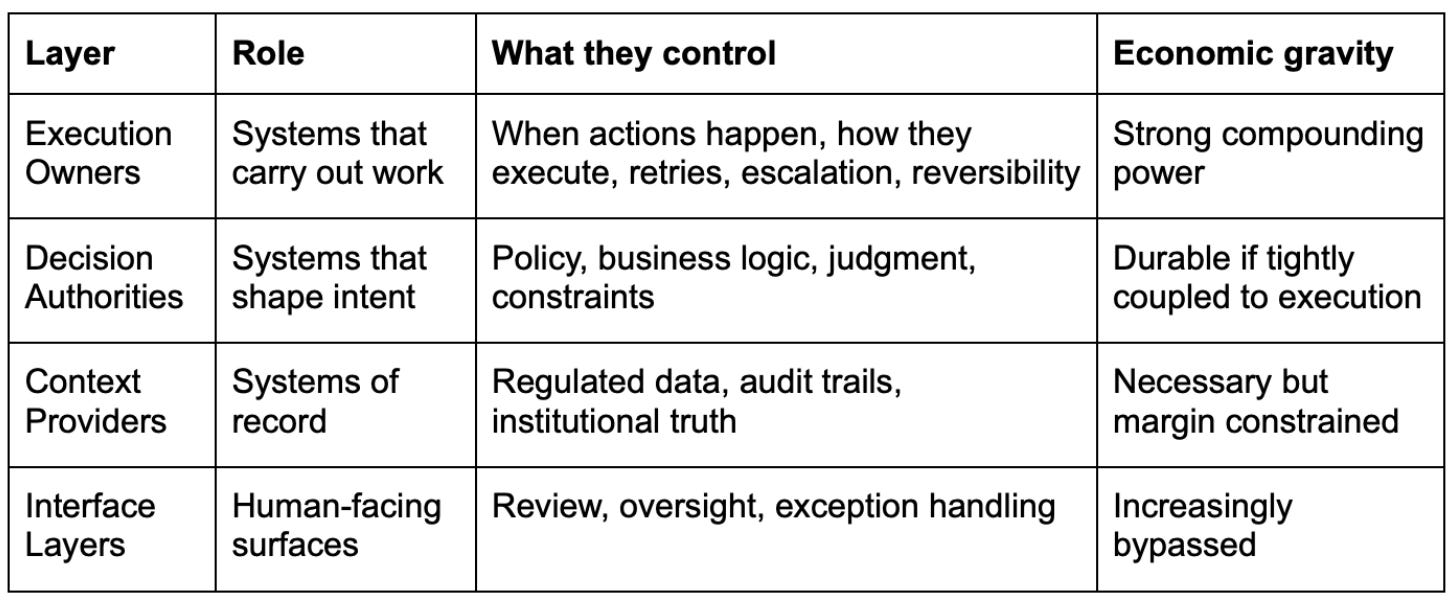
This framework clarifies why agentic systems expand total addressable market unevenly. The expansion concentrates in layers that decide and act, not in layers that record and display. Responsibility is expensive. Risk is expensive. Judgment under uncertainty is expensive. That is where enterprises concentrate spend.
Seen through this lens, legacy SaaS faces a fork in the road.
One path leads upward. Platforms evolve from systems of record into systems of authority. They take on decision logic, supervision, and execution guarantees. They earn trust not just as compliant repositories, but as actors operating within defined boundaries. This path is difficult, but it preserves pricing power because it aligns with where value is moving.
The other path leads inward. Platforms remain indispensable as governed context providers and trusted interfaces, but increasingly cede execution and decision-making to adjacent layers. They remain trusted as sources of record, but not as sources of action. Over time, efficiency pressures and abstraction erode margins, even as usage persists.
This is not a story of displacement. It is a story of rebalancing.
Many systems will remain in the stack. Fewer will remain in control.
The future of enterprise software is not decided by who stores context, but by who is trusted to act on it. Trust in this sense goes beyond compliance. It includes authority, explainability, reversibility, and the ability to intervene when autonomous systems encounter uncertainty.
As software stops being used and starts acting, its value is no longer defined solely by what it enables humans to do. It is defined by what it is permitted to do on its own. The platforms that endure will be the ones that move toward decision and execution, because that is where leverage, responsibility, and pricing power ultimately converge as software begins to act rather than be used.